
10 Science-Backed Study Techniques for Better Grades in 2026
Let's be honest: most study advice is garbage. "Just study harder" or "make colorful notes" might sound helpful, but they're not based on how learning actually works.
The truth is, cognitive science has given us powerful insights into effective learning – techniques that can dramatically improve your grades without increasing study time. Here are 10 science-backed methods that actually work.
1. Active Recall: Stop Re-Reading, Start Testing
What It Is
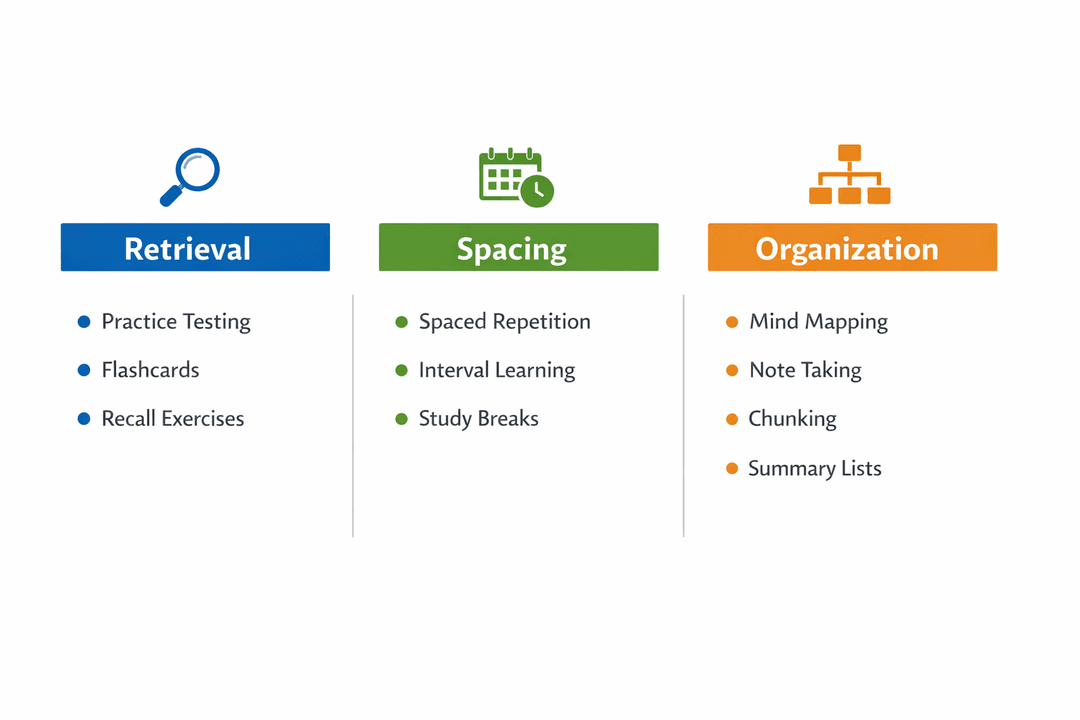
Active recall means retrieving information from memory rather than passively reviewing it. Instead of reading your notes again, you close them and try to remember what you learned.
Why It Works
Research shows active recall strengthens memory traces more than any other study method. A landmark 2008 study found that students who practiced active recall retained 80% more information than those who simply re-read material.
How to Do It
- Close your notes and write down everything you remember
- Use flashcards (not just reading them – actually recall the answer)
- Take practice tests before looking at solutions
- Explain concepts without referring to materials
Stuley Integration
Stuley's quiz and flashcard features are built around active recall. Our AI generates questions from your study materials, forcing retrieval rather than passive review.
2. Spaced Repetition: Strategic Review Timing
What It Is
Instead of cramming all your studying into one session, spaced repetition spreads reviews out over increasing intervals.
Why It Works
The spacing effect is one of the most robust findings in cognitive psychology. Information reviewed at strategic intervals is retained far longer than information crammed in a single session.
How to Do It
- Review new material after 1 day, then 3 days, then 7 days, then 14 days
- Use spaced repetition software to automate scheduling
- Resist the urge to cram before exams
Stuley Integration
Stuley's intelligent scheduling automatically spaces your reviews at optimal intervals based on your performance.
3. The Feynman Technique: Learn by Teaching
What It Is
Named after physicist Richard Feynman, this technique involves explaining concepts in simple language as if teaching someone else.
Why It Works
Teaching forces you to organize knowledge, identify gaps, and simplify complex ideas. If you can explain something simply, you truly understand it.
How to Do It
- Choose a concept
- Explain it as if teaching a 12-year-old
- Identify where your explanation breaks down
- Review those areas and simplify further
Stuley Integration
Stuley's Feynman AI lets you explain concepts and receive intelligent feedback, acting as your always-available study partner.
4. Interleaving: Mix It Up
What It Is
Instead of studying one topic until you master it (blocking), interleaving involves mixing different topics or problem types in a single study session.
Why It Works
Interleaving forces your brain to continuously retrieve different strategies, strengthening discrimination between concepts. Studies show it improves test performance by 25-76%.
How to Do It
- Study math, then switch to history, then back to math
- Practice different types of problems in one session
- Mix topics within subjects (e.g., calculus + algebra + geometry)
Common Mistake
Interleaving feels harder than blocking – many students think they're learning less. Trust the research; the difficulty is what makes it effective.
5. Elaborative Interrogation: Ask "Why?"
What It Is
Elaborative interrogation involves generating explanations for facts by asking "why" and "how" questions.
Why It Works
Creating explanations forces deeper processing and connects new information to existing knowledge. Research shows it improves learning by 40% compared to reading alone.
How to Do It
- For every fact, ask "Why is this true?"
- Ask "How does this connect to what I already know?"
- Generate your own examples
- Look for cause-and-effect relationships
Example
Instead of memorizing "The heart has four chambers," ask:
- Why does the heart need four chambers?
- How does this relate to blood circulation?
- What would happen with fewer chambers?
6. Dual Coding: Combine Words and Visuals
What It Is
Dual coding involves learning information through both verbal and visual channels – reading text while viewing diagrams, or creating visual representations of concepts.
Why It Works
The brain processes visual and verbal information through different channels. Using both creates multiple memory pathways, making recall more likely.
How to Do It
- Create diagrams and flowcharts for concepts
- Draw mind maps connecting ideas
- Visualize abstract concepts
- Use infographics and illustrations alongside text
Stuley Integration
Stuley helps you create visual summaries and mind maps from your study materials, automatically implementing dual coding.
7. The Pomodoro Technique: Focused Study Sprints
What It Is
The Pomodoro Technique involves studying in focused 25-minute intervals (pomodoros) followed by 5-minute breaks.
Why It Works
Our brains aren't designed for hours of continuous focus. Short, intense study sessions with breaks maintain high attention and prevent mental fatigue.
How to Do It
- Set a timer for 25 minutes
- Study with complete focus (no distractions)
- Take a 5-minute break
- After 4 pomodoros, take a 15-30 minute break
Pro Tips
- During breaks, avoid screens – walk, stretch, or rest your eyes
- Adjust the interval length to what works for you (some prefer 50/10)
- Track completed pomodoros for motivation
8. Sleep-Based Memory Consolidation
What It Is
Strategic use of sleep to enhance memory formation, including reviewing material before bed and ensuring adequate sleep quality.
Why It Works
During sleep, your brain consolidates memories and moves information from short-term to long-term storage. Sleep-deprived students show significantly worse retention.
How to Do It
- Review important material briefly before sleep
- Get 7-9 hours of quality sleep
- Maintain consistent sleep schedules
- Consider short naps (10-20 minutes) after intensive study
The Research
Students who sleep after learning retain 40% more information than those who stay awake for the same period.
9. Concrete Examples: Make It Real
What It Is
Using specific, concrete examples to illustrate abstract concepts and principles.
Why It Works
Abstract concepts are hard to grasp and remember. Concrete examples provide mental anchors that make ideas tangible and memorable.
How to Do It
- For every abstract concept, generate 2-3 real-world examples
- Create analogies to familiar situations
- Apply theories to specific scenarios
- Connect academic concepts to personal experiences
Example
Abstract: "Supply and demand affect prices" Concrete: "When Taylor Swift announces a concert, ticket prices skyrocket because demand exceeds supply"
10. Metacognition: Think About Your Thinking
What It Is
Metacognition involves being aware of and controlling your own learning process – knowing what you know, what you don't know, and what strategies work for you.
Why It Works
Students who practice metacognition learn more effectively because they can identify weaknesses, adjust strategies, and allocate study time wisely.
How to Do It
- Before studying, ask: "What do I already know? What do I need to learn?"
- During studying, ask: "Is this working? Am I understanding this?"
- After studying, ask: "What did I learn? What gaps remain?"
- Track which techniques work best for you
Stuley Integration
Stuley's analytics help you practice metacognition by showing performance data, identifying weak areas, and tracking which study methods are most effective for you.
Putting It All Together: A Science-Based Study System
Here's how to combine these techniques into an effective study routine:
Before Each Session
- Review what you need to learn (metacognition)
- Set a Pomodoro timer for focused study
- Prepare materials for active recall and interleaving
During Each Session
- Use active recall – test yourself constantly
- Apply elaborative interrogation – ask "why" and "how"
- Employ dual coding – create visuals alongside text
- Use concrete examples to anchor abstract concepts
- Interleave topics within your session
After Each Session
- Briefly explain what you learned (Feynman Technique)
- Note any gaps for future study (metacognition)
- Schedule spaced repetition reviews
- If studying before bed, do a final brief review
How Stuley Brings It All Together
At Stuley, we've built a study platform that integrates all of these science-backed techniques:
- Active Recall: AI-generated quizzes and flashcards
- Spaced Repetition: Intelligent review scheduling
- Feynman Technique: Feynman AI for teaching practice
- Dual Coding: Visual summaries and mind maps
- Metacognition: Performance analytics and gap identification
- Golden Time: Study scheduling during peak hours
The Bottom Line
You don't need to study more – you need to study smarter. These 10 techniques are backed by decades of cognitive science research. They work.
The students who excel aren't necessarily the smartest or the hardest working. They're the ones who study effectively.
Start implementing these techniques today. Your future grades depend on the methods you use, not just the hours you put in.
Ready to study smarter? Stuley combines all these science-backed techniques into one AI-powered platform. Start your free trial today.


