The Feynman Technique: Learn Anything Faster with AI
Richard Feynman was a Nobel Prize-winning physicist known not just for his groundbreaking work in quantum electrodynamics, but for his extraordinary ability to explain complex concepts in simple terms. His approach to learning has become one of the most powerful study techniques available: The Feynman Technique.
Now, with the power of AI, we can supercharge this timeless method. Let's explore how.
What is the Feynman Technique?
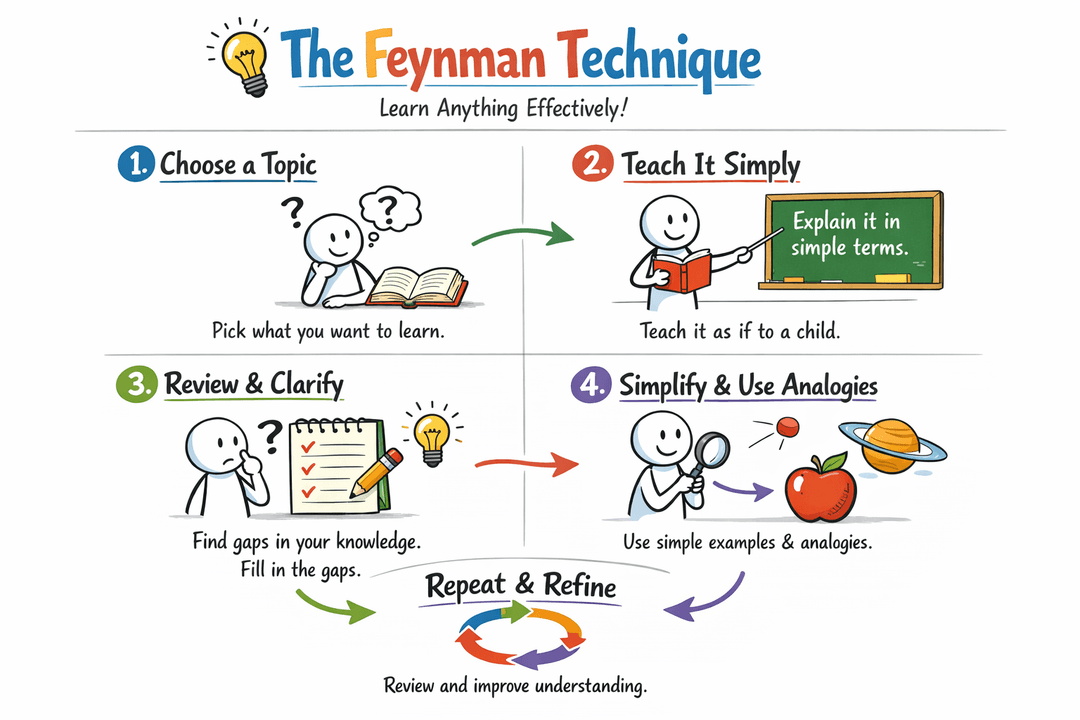
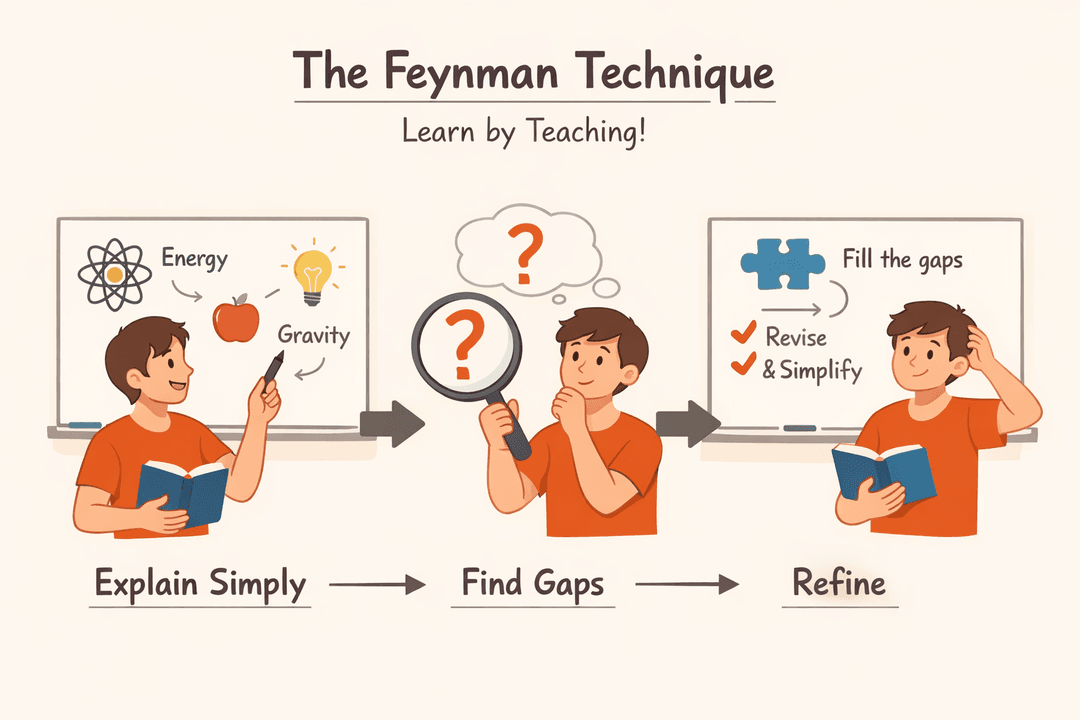
The Feynman Technique is a four-step learning method based on a simple principle: The best way to learn is to teach.
When you try to explain a concept to someone else (or even to yourself), you quickly discover gaps in your understanding. These gaps reveal exactly what you need to study more.
The Four Steps
- Choose a concept - Select something you want to understand deeply
- Teach it to a child - Explain the concept in simple language, as if teaching a 12-year-old
- Identify gaps - Notice where your explanation breaks down or becomes confusing
- Review and simplify - Go back to your sources, fill the gaps, and simplify your explanation further
Why Does the Feynman Technique Work So Well?
Active Learning vs. Passive Learning
Most students fall into the trap of passive learning:
- Highlighting textbooks
- Re-reading notes
- Watching lecture videos
These activities feel productive but don't create deep understanding. The Feynman Technique forces active learning – you must construct knowledge, not just consume it.
The Illusion of Competence
Have you ever read something and felt like you understood it, only to realize later you couldn't explain it? This is called the illusion of competence – a common trap that wastes countless study hours.
The Feynman Technique shatters this illusion immediately. When you try to explain something simply, you can't hide behind jargon or half-understood concepts.
The Challenge: Finding Someone to Teach
Here's the problem with the traditional Feynman Technique: you need someone to teach.
Sure, you can talk to yourself or write explanations in a notebook, but you're missing crucial feedback:
- Are your explanations actually clear?
- What follow-up questions might someone ask?
- Where are your explanations still too complex?
This is where AI changes everything.
Enter Feynman AI: Your Always-Available Learning Partner
At Stuley, we've developed Feynman AI – an intelligent learning companion designed specifically to help you master the Feynman Technique.
How Feynman AI Works
- You explain a concept - Type or speak your explanation to Feynman AI
- AI asks probing questions - Like a curious student, it asks follow-up questions
- Identifies gaps in understanding - Points out areas that need clarification
- Suggests simplifications - Helps you remove jargon and complexity
- Confirms mastery - Validates when your explanation demonstrates true understanding
Real-Time Feedback Loop
Unlike explaining to a notebook, Feynman AI provides instant, intelligent feedback:
- "Can you explain what you mean by [complex term]?"
- "I'm confused about how X connects to Y"
- "Could you give an example of this?"
- "Great explanation! You clearly understand this concept."
This feedback loop accelerates learning dramatically.
The Science of Teaching to Learn
Research consistently shows that teaching is one of the most effective learning methods:
The Protege Effect
Studies show that when students expect to teach material, they:
- Learn more thoroughly
- Organize information better
- Remember it longer
This is called the protege effect – and it works even when teaching an AI.
Elaborative Interrogation
Feynman AI uses a technique called elaborative interrogation – asking "why" and "how" questions that force deeper processing. Research shows this improves retention by 40% compared to passive review.
Practical Examples: Feynman Technique in Action
Example 1: Learning Photosynthesis
Without Feynman Technique: "Photosynthesis is the process by which plants convert light energy into chemical energy stored in glucose molecules through a series of reactions in the chloroplasts."
With Feynman Technique (talking to Feynman AI):
You: "Plants are like tiny factories that make their own food using sunlight."
Feynman AI: "Interesting! How exactly do they capture the sunlight?"
You: "They have special green parts called chlorophyll that absorb light..."
Feynman AI: "And what do they do with that captured light energy?"
You: "Hmm, I know they combine it with water and CO2... let me think about the exact process..."
See how the conversation reveals what you truly understand and what needs more study?
Example 2: Understanding Compound Interest
Without Feynman Technique: "Compound interest is the interest on a loan or deposit calculated based on both the initial principal and the accumulated interest from previous periods."
With Feynman Technique:
You: "Imagine you have a snowball. Each time it rolls, it picks up more snow. Compound interest is like that – your money picks up 'interest snow' and the bigger it gets, the more it picks up."
Feynman AI: "I like that analogy! Can you explain how the interest actually gets added?"
This process creates understanding that lasts.
How to Use Feynman AI in Your Study Routine
Step 1: After Learning New Material
Immediately after a lecture or reading session, open Stuley and explain what you learned to Feynman AI. This identifies gaps while the material is fresh.
Step 2: Before Exams
Use Feynman AI to explain key concepts without looking at your notes. This reveals what you truly know vs. what you only think you know.
Step 3: For Difficult Concepts
When something just won't click, teaching it to Feynman AI forces you to break it down into smaller pieces until understanding emerges.
Step 4: Combined with Spaced Repetition
Stuley integrates Feynman AI with our spaced repetition system. After you explain a concept well, we'll prompt you to explain it again at optimal intervals to cement long-term retention.
Why AI Makes the Feynman Technique 10x More Effective
| Traditional Approach | With Feynman AI |
|---|---|
| No feedback | Instant, intelligent feedback |
| Can fool yourself | AI catches gaps and unclear explanations |
| Limited practice opportunities | Practice anytime, anywhere |
| Static teaching | Adaptive questions based on your explanation |
| Time-consuming to find study partners | Always available |
Real Student Results
Students using Feynman AI report:
- 53% faster concept mastery
- 72% better exam performance on conceptual questions
- 45% reduction in time spent re-learning forgotten material
- 91% feel more confident about their understanding
Getting Started with Feynman AI
Ready to transform how you learn? Here's your action plan:
- Sign up for Stuley at stuley.com
- Upload your study material or select a topic
- Start explaining to Feynman AI
- Follow the feedback to improve your understanding
- Watch your grades improve
Conclusion
The Feynman Technique has helped millions of students achieve deep understanding. Now, with AI, this powerful method is more accessible and effective than ever.
Stop highlighting textbooks. Stop re-reading notes. Start teaching – and truly learn.
If you can't explain it simply, you don't understand it well enough. Let Feynman AI help you get there.
Experience the power of Feynman AI. Start learning smarter with Stuley – your AI-powered study companion.