How AI is Transforming Education and Study Habits in 2026
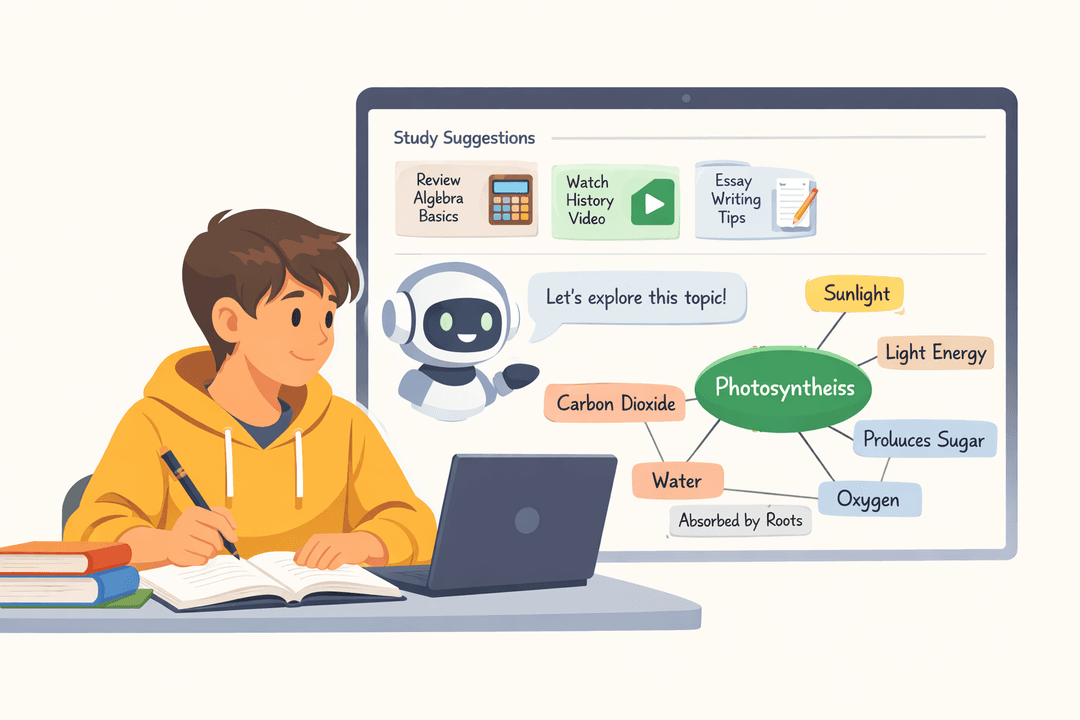
Artificial intelligence isn't just changing how we work and communicate – it's fundamentally transforming how we learn. For students, this revolution means access to tools that would have seemed like science fiction just a few years ago.
From personalized tutoring available 24/7 to intelligent study systems that know exactly what you need to review, AI is making effective learning accessible to everyone. Here's what every student should know about this transformation.
The AI Education Revolution
From One-Size-Fits-All to Personalized Learning
Traditional education follows a rigid structure:
- Same pace for everyone
- Same materials for everyone
- Same explanations for everyone
- Limited feedback and adaptation
AI enables something different:
- Learning paths adapted to individual needs
- Materials adjusted to your level
- Explanations in the style you understand best
- Continuous feedback and optimization
Why This Matters for Students
Research consistently shows that personalized instruction dramatically improves outcomes:
- 2-sigma improvement: Students with personal tutors perform 2 standard deviations better than classroom-only students
- AI can approximate this: At scale, affordably, and accessibly
For the first time in history, every student can access personalized learning support.
Key AI Technologies Changing Learning
1. Intelligent Tutoring Systems
AI tutors can:
- Explain concepts in multiple ways until you understand
- Ask probing questions to test comprehension
- Identify exactly where confusion occurs
- Provide immediate, personalized feedback
Unlike human tutors, they're:
- Available 24/7
- Infinitely patient
- Consistent in quality
- Affordable at scale
2. Adaptive Learning Platforms
These systems continuously adjust to you:
- Content difficulty: Increases or decreases based on performance
- Review timing: Schedules practice at optimal intervals
- Learning paths: Routes you through material efficiently
- Attention allocation: Focuses on what you need most
3. Natural Language Processing
AI can now understand and generate human language:
- Explain in your words: Describe concepts and get feedback
- Ask any question: Get instant, accurate answers
- Write with assistance: Grammar, style, and content support
- Summarize material: Long documents condensed intelligently
4. Content Generation
AI can create educational materials:
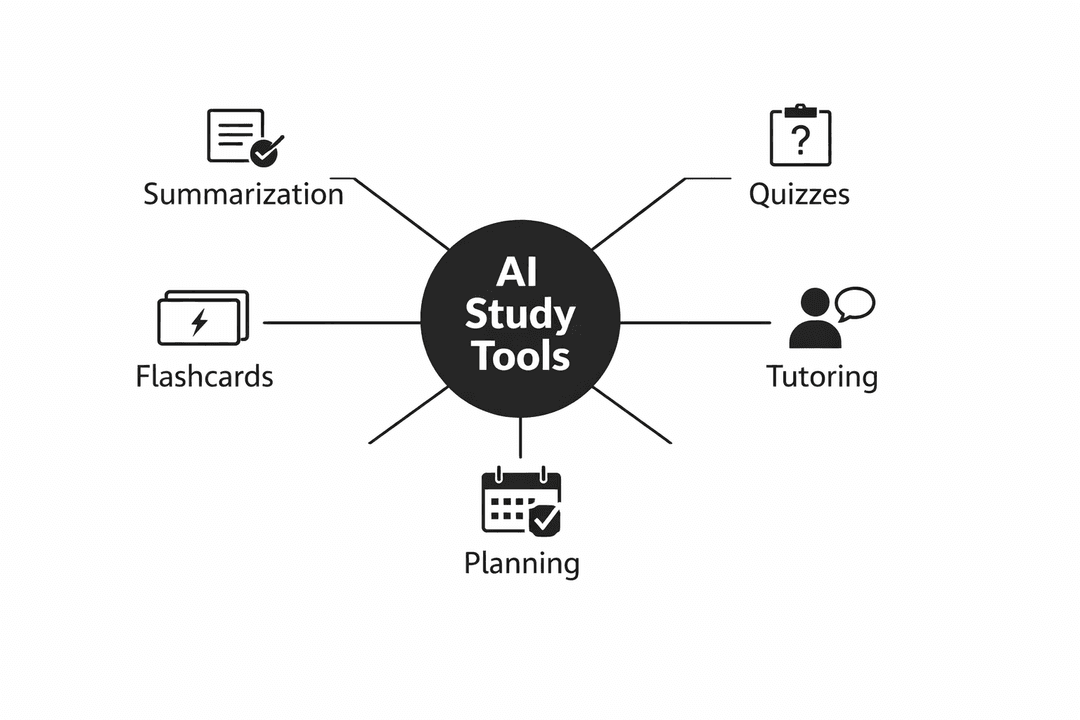
- Practice questions: Unlimited quizzes from any content
- Flashcards: Auto-generated from notes or textbooks
- Summaries: Key points extracted automatically
- Study guides: Personalized based on your needs
How Students Are Using AI Today
For Study Material Creation
Before AI:
- Hours creating flashcards manually
- Guessing what questions might appear
- Limited practice opportunities
With AI:
- Upload any material, get flashcards instantly
- AI generates likely exam questions
- Unlimited practice with immediate feedback
For Understanding Difficult Concepts
Before AI:
- Re-read confusing passages repeatedly
- Wait for office hours or tutoring
- Struggle alone with frustration
With AI:
- Ask for alternative explanations instantly
- Get personalized analogies and examples
- Engage in back-and-forth dialogue until understanding
For Exam Preparation
Before AI:
- Study everything equally
- Hope you focused on the right material
- Limited practice testing
With AI:
- Focus on proven weak areas
- Confidence in comprehensive coverage
- Extensive practice with intelligent feedback
The Stuley Approach to AI Learning
At Stuley, we've built AI tools specifically designed to enhance how students learn:
Feynman AI: Your Personal Teaching Assistant
Based on the renowned Feynman Technique:
- Explain any concept to Feynman AI
- Receive probing questions that test your understanding
- Identify gaps you didn't know existed
- Get guided feedback to deepen comprehension
This isn't just Q&A – it's active learning that builds true understanding.
Smart Content Processing
Upload any study material:
- Lecture recordings and videos
- PDF textbooks and articles
- Notes (typed or handwritten)
- Slides and presentations
AI automatically:
- Extracts key concepts
- Creates summaries
- Generates flashcards
- Builds quiz questions
- Maps connections between ideas
Intelligent Spaced Repetition
Our AI optimizes your review schedule:
- Personalized intervals: Based on your performance
- Adaptive difficulty: Questions adjusted to your level
- Weakness targeting: Focus where you need it most
- Confidence tracking: Know when you're ready
Performance Analytics
AI-powered insights into your learning:
- Which topics need more attention
- When you study most effectively
- How your retention improves over time
- Predictions for exam readiness
Practical AI Study Strategies
Strategy 1: AI-Assisted Note Processing
After each lecture:
- Upload notes to an AI study tool
- Review AI-generated summaries
- Study auto-created flashcards
- Test yourself with generated questions
Time saved: Hours per week Benefit: Better retention with less effort
Strategy 2: Conversation-Based Learning
Instead of passive reading:
- Read/watch the material once
- Explain concepts to an AI (like Feynman AI)
- Answer AI's probing questions
- Iterate until explanation is clear and complete
Benefit: Deep understanding, not surface memorization
Strategy 3: AI Practice Testing
Before exams:
- Have AI generate practice questions from your material
- Take practice tests under exam conditions
- Review AI-provided feedback on mistakes
- Focus additional study on weak areas
- Repeat until confident
Benefit: Targeted preparation, reduced anxiety
Strategy 4: Multi-Modal Learning
Use AI to experience material multiple ways:
- Read the original text
- Get AI summaries
- Create visual mind maps
- Engage in Q&A dialogue
- Review with flashcards
Benefit: Multiple memory pathways, stronger retention
Addressing Concerns About AI in Education
"Isn't this just cheating?"
There's an important distinction:
Using AI to avoid learning: Cheating
- Having AI write your essays
- Using AI on exams
- Copying AI-generated answers
Using AI to enhance learning: Smart
- Using AI to create study materials
- Getting explanations of difficult concepts
- Practicing with AI-generated questions
The goal is learning, not shortcuts. AI study tools are like having access to a great tutor – they help you learn, not replace the learning.
"Will I become dependent on AI?"
Effective AI learning tools:
- Build understanding, not dependence
- Develop skills you can use anywhere
- Prepare you for AI-assisted workplaces
- Enhance rather than replace human capability
"Is AI accurate enough to trust?"
Modern AI is highly capable but not perfect:
- Use AI as a tool, not an authority
- Verify important information
- Develop critical thinking about AI outputs
- Combine AI assistance with traditional sources
The Future of AI in Education
Near-Term (Next 2-3 Years)
- More sophisticated tutoring conversations
- Better understanding of individual learning styles
- Integration with VR/AR learning environments
- Real-time learning analytics and intervention
Medium-Term (3-7 Years)
- Truly personalized curriculum generation
- AI that knows your complete learning history
- Seamless integration across all educational tools
- Predictive systems that prevent learning struggles
Long-Term Vision
- Learning experiences adapted in real-time
- Education accessible to everyone, everywhere
- Mastery-based progression replacing time-based
- Lifelong learning supported by AI companions
Getting Started with AI Study Tools
Evaluate Your Needs
- What subjects do you struggle with most?
- Where do you spend the most study time?
- What aspects of studying frustrate you?
Start Small
Don't overhaul everything at once:
- Pick one AI tool to try
- Use it for one subject
- Evaluate the results
- Expand based on experience
Recommendations
For flashcards and spaced repetition: Stuley For understanding concepts: Stuley's Feynman AI For content summarization: AI-powered note tools For practice testing: AI question generators
Making the Most of AI Learning Tools
Do
- Use AI to enhance understanding
- Combine AI tools with traditional study
- Practice active learning with AI assistance
- Track your progress and adjust
Don't
- Replace thinking with AI
- Trust AI without verification
- Use AI to avoid learning
- Become passive in your education
Conclusion
AI is not replacing human learning – it's enhancing it. The students who thrive in this new era will be those who learn to leverage AI effectively while developing genuine understanding and skills.
The tools are here. The research supports their effectiveness. The question is whether you'll embrace them.
The future of learning is personalized, intelligent, and accessible. And it's available to you today.
Experience the future of learning. Stuley combines cutting-edge AI with proven learning science to help you study smarter. Try it free and see the difference AI can make.