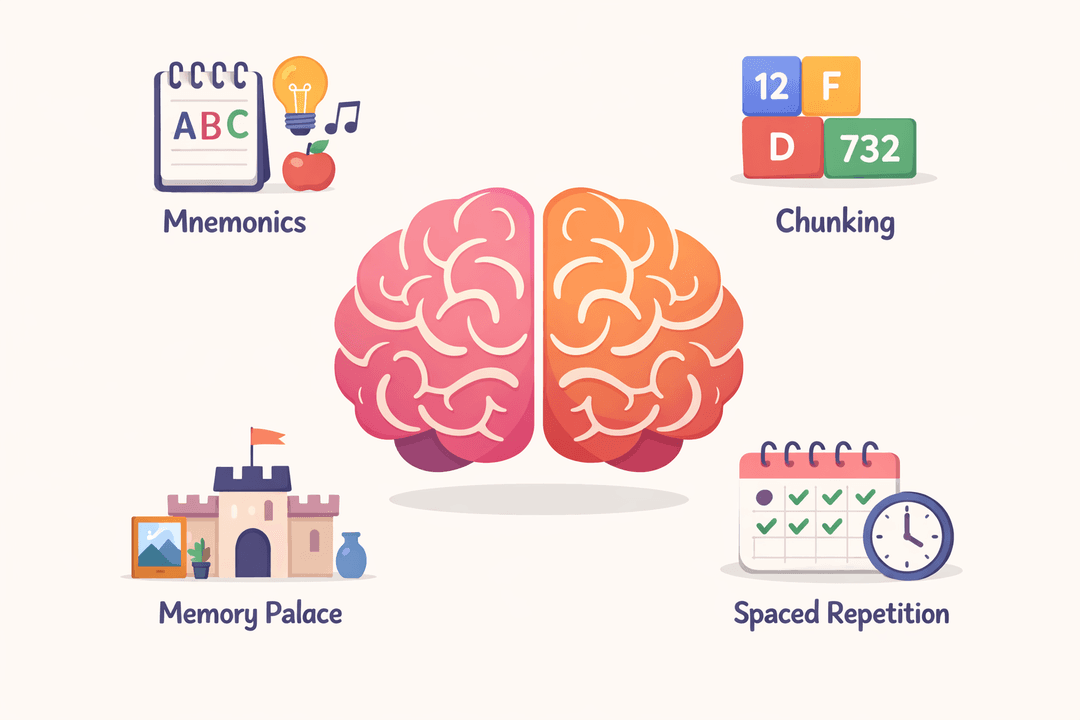
Memory Techniques Every Student Should Know
Ever wondered how memory champions can memorize the order of a shuffled deck of cards in seconds? Or how some students seem to effortlessly remember everything while others struggle?
The secret isn't a special brain – it's technique. Memory is a skill that can be trained, and the techniques used by memory experts can be learned by anyone.
In this guide, you'll discover the most effective memory techniques and how to apply them to your studies.
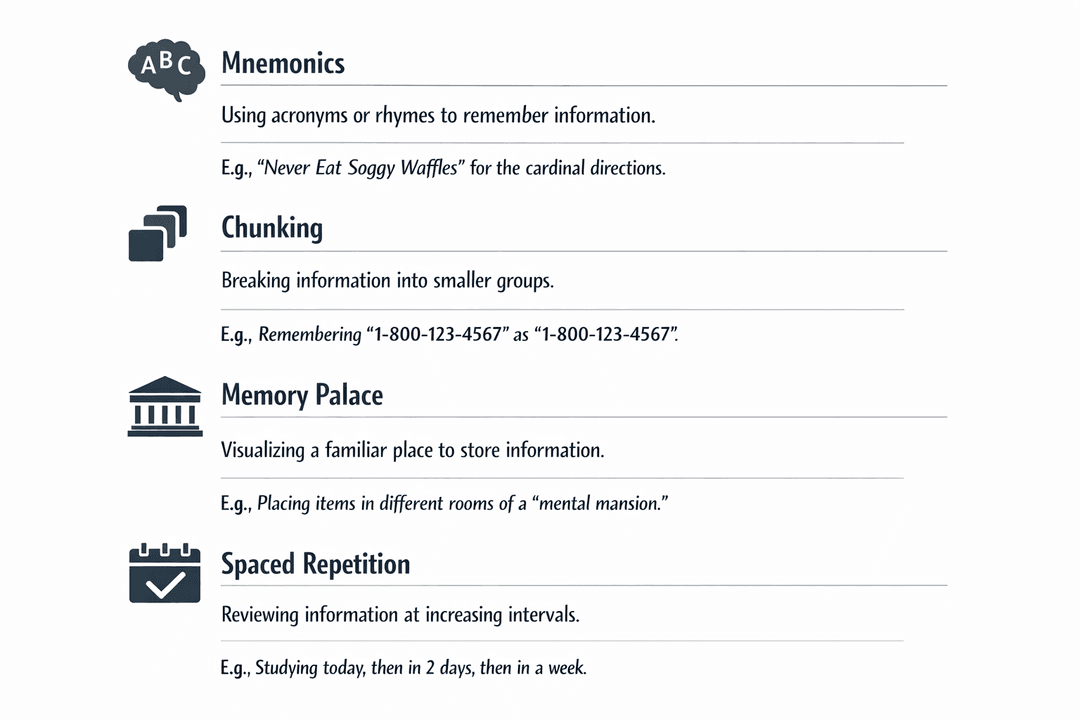
How Memory Really Works
Before diving into techniques, understanding how memory works helps explain why these methods are so effective.
The Three Stages of Memory
- Encoding: Information enters your brain
- Storage: Information is retained over time
- Retrieval: Information is accessed when needed
Most study problems occur at encoding or retrieval. The techniques below optimize both.
What Makes Memories Stick
Research shows memories are stronger when they are:
- Emotional: Connected to feelings
- Visual: Associated with images
- Novel: Unique or unusual
- Connected: Linked to existing knowledge
- Repeated: Retrieved multiple times
Effective memory techniques leverage these principles.
Technique 1: Mnemonics
What Are Mnemonics?
Mnemonics are memory devices that help you encode information in a more memorable way. They transform abstract or difficult information into something easier to remember.
Types of Mnemonics
Acronyms: First letters form a word
- ROY G BIV (colors of the rainbow)
- HOMES (Great Lakes: Huron, Ontario, Michigan, Erie, Superior)
Acrostics: First letters form a sentence
- "My Very Eager Mother Just Served Us Nachos" (planets)
- "Every Good Boy Does Fine" (musical notes)
Rhymes: Information set to rhythm
- "In 1492, Columbus sailed the ocean blue"
- "Thirty days hath September..."
Visual Associations: Linking images to information
- Imagine a giant ear to remember "aural" means related to hearing
- Picture a desert to remember "arid" means dry
Creating Effective Mnemonics
- Make them personal – use references meaningful to you
- Make them vivid – unusual and exaggerated images work better
- Make them simple – easy to recall under pressure
- Practice retrieval – mnemonics need reinforcement too
When to Use Mnemonics
Best for:
- Lists and sequences
- Terminology and definitions
- Facts and dates
- Formulas (sometimes)
Less ideal for:
- Complex concepts
- Large amounts of interconnected information
- Material requiring deep understanding
Technique 2: Chunking
What Is Chunking?
Chunking is the process of grouping individual pieces of information into larger, meaningful units.
Example: Phone numbers are chunked
- Hard: 5551234567
- Easy: 555-123-4567
The Science Behind Chunking
Working memory can only hold about 7 (plus or minus 2) items at once. Chunking reduces the number of items by grouping them, allowing you to remember more.
How to Chunk Information
Step 1: Identify natural groupings Step 2: Create meaningful categories Step 3: Label each chunk Step 4: Practice retrieving by chunk
Chunking in Practice
For vocabulary:
- Group by theme (food words, travel words)
- Group by root (words with "bio-")
- Group by grammatical function (verbs, nouns)
For history:
- Group by time period
- Group by geographic region
- Group by cause-and-effect chains
For science:
- Group by system (digestive, circulatory)
- Group by classification
- Group by process steps
Technique 3: The Memory Palace (Method of Loci)
What Is a Memory Palace?
The Memory Palace technique uses spatial memory to store information. You mentally place items to remember along a familiar route or in a familiar location.
Why It Works
Humans have exceptional spatial memory – we evolved to remember locations for survival. By linking information to places, we piggyback on this powerful memory system.
Creating Your Memory Palace
Step 1: Choose a familiar location
- Your home
- Your route to school
- A video game environment you know well
Step 2: Identify specific locations within it
- Front door
- Living room couch
- Kitchen table
- Bedroom desk
Step 3: Create a consistent route Always travel through the space in the same order.
Step 4: Place items to remember Create vivid, exaggerated images at each location.
Example: Remembering a Biology List
Items to remember: Nucleus, Mitochondria, Ribosomes, Endoplasmic Reticulum, Golgi Apparatus
Your bedroom palace:
- Front door: A giant nucleus (like a basketball with a visible nucleolus) is blocking the entrance
- Hallway: Tiny mitochondria are running on treadmills, producing energy (powerhouse of the cell)
- Living room couch: Ribosomes (like tiny raisins) are reading blueprints and building proteins
- Kitchen: The endoplasmic reticulum is like a maze of hallways where the delivery people are carrying packages
- Bedroom: The Golgi apparatus is a stack of golden pancakes (Golgi) being packaged for shipping
Tips for Effective Memory Palaces
- Make images unusual and vivid
- Use action – things moving are more memorable
- Include sensory details – sounds, smells, textures
- Review your palace regularly
- Build multiple palaces for different subjects
Technique 4: Elaborative Encoding
What Is Elaborative Encoding?
Elaborative encoding means connecting new information to existing knowledge through meaningful associations.
How to Practice It
Ask "Why?": For every fact, ask why it's true
- Don't just memorize "The heart has four chambers"
- Ask "Why does the heart need four chambers?"
Make connections: Link to what you know
- "This economics concept is like..."
- "This reminds me of..."
Generate examples: Create your own illustrations
- If learning about gravity, think of specific examples from your life
Explain it: Put concepts in your own words
The Depth of Processing Effect
Research shows that information processed deeply (with meaning) is remembered better than information processed shallowly (just the surface features).
Shallow: "Photosynthesis has 12 letters" Deep: "Photosynthesis is how plants make food using sunlight – like a kitchen powered by the sun"
Technique 5: Spaced Repetition
What Is Spaced Repetition?
Spaced repetition is reviewing information at increasing intervals over time, rather than all at once.
The Forgetting Curve
Without review, we forget:
- 50% within 1 hour
- 70% within 24 hours
- 90% within a week
Spaced repetition interrupts this curve at optimal moments.
Optimal Spacing
A typical schedule:
- 1st review: 1 day after learning
- 2nd review: 3 days later
- 3rd review: 1 week later
- 4th review: 2 weeks later
- 5th review: 1 month later
How Stuley Optimizes Spacing
Stuley uses AI to perfect your spacing schedule:
- Algorithms adapt to your individual forgetting rate
- Difficult items are shown more frequently
- Easy items have longer intervals
- Reviews are scheduled at optimal times
You don't have to track anything – the system handles it automatically.
Technique 6: Dual Coding
What Is Dual Coding?
Dual coding combines verbal and visual information, creating two memory pathways instead of one.
How to Use Dual Coding
While reading:
- Visualize what you're reading
- Draw diagrams of processes
- Create mental images of concepts
While taking notes:
- Include sketches and diagrams
- Use color coding
- Create visual organizers
While reviewing:
- Convert text to images
- Create mind maps
- Use flowcharts for processes
Visual Formats
- Mind maps: Central concept with radiating branches
- Flowcharts: Process steps in sequence
- Diagrams: Visual representation of systems
- Timelines: Events in chronological order
- Comparison tables: Side-by-side features
Technique 7: Active Recall
What Is Active Recall?
Active recall is retrieving information from memory rather than passively reviewing it.
Why It's So Powerful
Every time you successfully retrieve a memory, you strengthen it. Passive review (re-reading) doesn't have this effect.
Active Recall Methods
- Flashcards: Look at question, recall answer before flipping
- Blank page method: Write everything you know without notes
- Practice questions: Test yourself before checking answers
- Teaching: Explain concepts to others (or to AI)
Combining with Other Techniques
Active recall works best when combined with:
- Spaced repetition: Retrieve at optimal intervals
- Elaborative encoding: Connect during retrieval
- Mnemonics: Use memory aids during recall
Putting It All Together: A Memory-Enhanced Study System
When Learning New Material
- Chunk information into meaningful groups
- Create mnemonics for lists and terminology
- Use dual coding – visualize and diagram
- Practice elaborative encoding – connect to what you know
When Reviewing
- Use active recall – test yourself, don't re-read
- Follow spaced repetition schedule
- Walk through memory palaces for complex sequences
- Explain concepts to verify understanding
When Preparing for Exams
- Build memory palaces for challenging material
- Review mnemonics under time pressure
- Practice active recall under exam conditions
- Use Stuley to optimize your review schedule
Common Memory Mistakes to Avoid
Mistake 1: Relying on Re-reading
Re-reading creates familiarity, not memory. Use active recall instead.
Mistake 2: Cramming
Massed practice is far less effective than spaced practice, even with the same total time.
Mistake 3: Ignoring Sleep
Sleep is essential for memory consolidation. All-nighters hurt more than they help.
Mistake 4: Passive Note Review
Looking at notes doesn't strengthen memory. Testing yourself does.
Mistake 5: Using Only One Technique
Combine techniques for best results. Mnemonics + spaced repetition + active recall is powerful.
How Stuley Enhances Memory
At Stuley, we've built memory science into every feature:
Intelligent Spaced Repetition
- AI-optimized review schedules
- Personalized to your forgetting rate
- Automatic adjustment based on performance
Active Recall Focus
- Flashcards designed for retrieval practice
- AI-generated quiz questions
- Feynman AI for explanation practice
Dual Coding Support
- Visual summaries and mind maps
- Multiple representation formats
- Connected concept visualization
Progress Tracking
- See your memory improvement over time
- Identify topics needing more attention
- Build confidence through data
Start Building Your Memory Today
This Week's Practice
Day 1-2: Create a memory palace for one topic Day 3-4: Develop mnemonics for key terms Day 5: Practice chunking for a complex chapter Day 6: Combine techniques in one study session Day 7: Test yourself using active recall
Ongoing Habits
- Always test yourself, never just review
- Space your practice over time
- Use visuals alongside text
- Connect new information to existing knowledge
- Get adequate sleep for memory consolidation
Conclusion
Memory isn't a fixed trait – it's a skill that improves with the right techniques and practice. The methods in this guide are used by memory champions, top students, and learning scientists worldwide.
You don't need a special brain. You need the right techniques and consistent practice.
Start using these methods today, and watch your ability to learn and remember transform.
Optimize your memory with AI assistance. Stuley combines proven memory techniques with intelligent scheduling to help you remember everything you study. Try it free today.