Active Recall: The #1 Study Method Backed by Science
If there's one study technique that consistently outperforms all others in scientific research, it's active recall. Yet most students have never heard of it – and those who have often don't know how to use it effectively.
In this comprehensive guide, you'll learn exactly what active recall is, why it works so well, and how to implement it in your study routine starting today.
What is Active Recall?
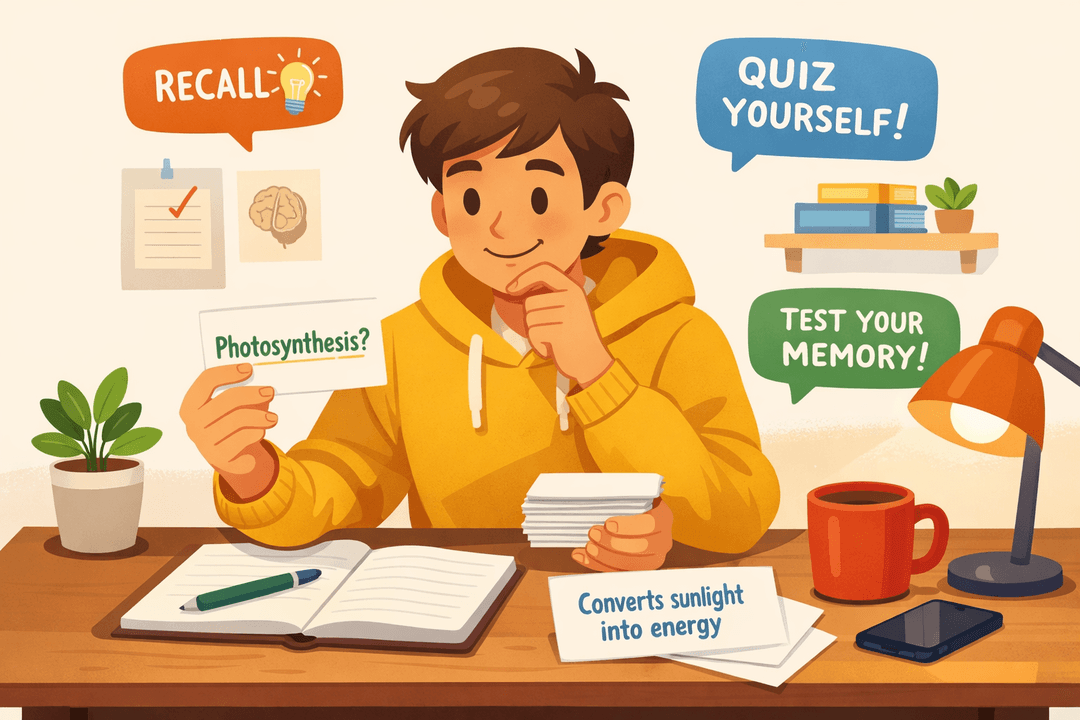
Active recall is the practice of stimulating your memory during the learning process by retrieving information from your brain rather than passively reviewing it.
Instead of:
- Re-reading your textbook
- Highlighting passages
- Reviewing notes passively
You:
- Close your book and try to remember key concepts
- Test yourself with questions
- Write down everything you know without looking
The fundamental principle is simple: every time you actively retrieve a memory, you strengthen it.
The Science: Why Active Recall Works
The Testing Effect
The "testing effect" (also called "retrieval practice") is one of the most robust findings in cognitive psychology. Research dating back to 1909 has consistently shown that testing yourself produces better learning than re-studying.
Key Study: In a landmark 2008 experiment, students who practiced active recall retained 50% more information after one week compared to students who used traditional study methods.
How It Strengthens Memory
When you practice active recall, several things happen in your brain:
- Neural pathway reinforcement: Each retrieval attempt strengthens the synaptic connections associated with that memory
- Elaborative encoding: Your brain creates multiple retrieval routes to the same information
- Identification of gaps: You immediately discover what you don't know
- Desirable difficulty: The effort of retrieval enhances long-term retention
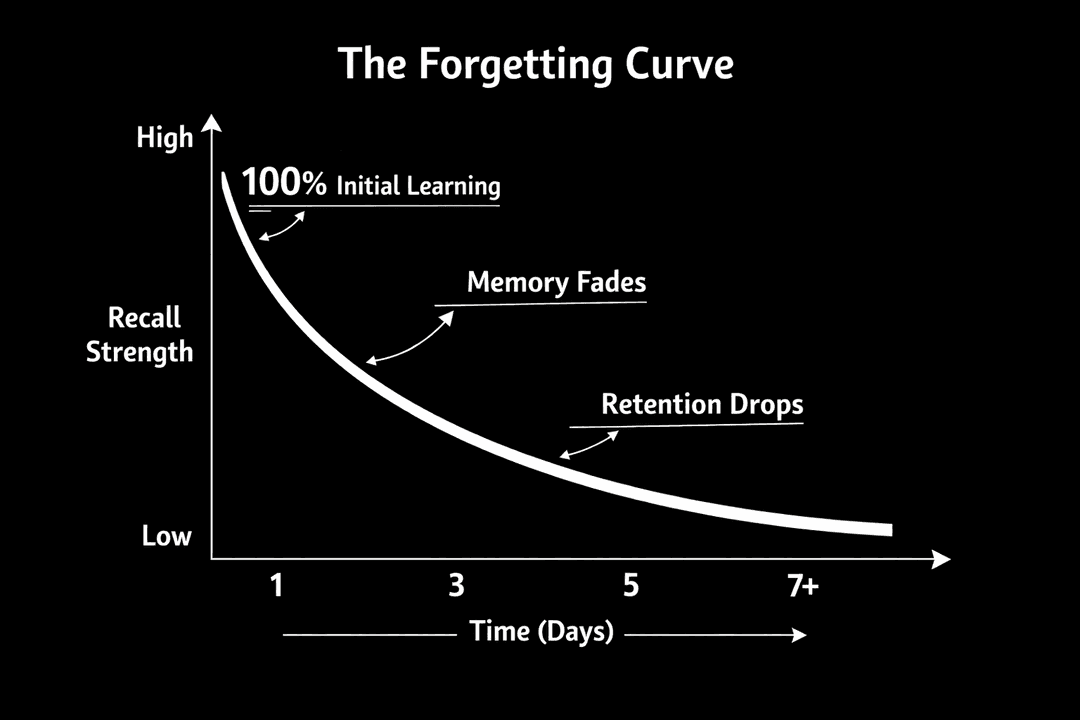
The Fluency Illusion
Here's why passive studying feels effective but isn't:
When you re-read material, it becomes familiar. This familiarity creates a fluency illusion – you feel like you know it because it seems easy to process. But recognition is not the same as recall.
On exam day, you need to produce information, not just recognize it. Active recall trains your brain for exactly this task.
Active Recall vs. Other Study Methods
| Method | Effectiveness | Time Required | Difficulty |
|---|---|---|---|
| Active Recall | Very High | Low-Medium | High |
| Spaced Repetition | Very High | Low | Medium |
| Practice Tests | High | Medium | High |
| Note-taking | Medium | High | Low |
| Re-reading | Low | High | Low |
| Highlighting | Very Low | Low | Very Low |
How to Practice Active Recall: 7 Proven Techniques
1. The Blank Page Method
After studying a topic:
- Close all your materials
- Take a blank sheet of paper
- Write down everything you can remember
- Check your notes and fill in gaps
- Repeat until you can recall everything
Best for: Initial learning and comprehensive topics
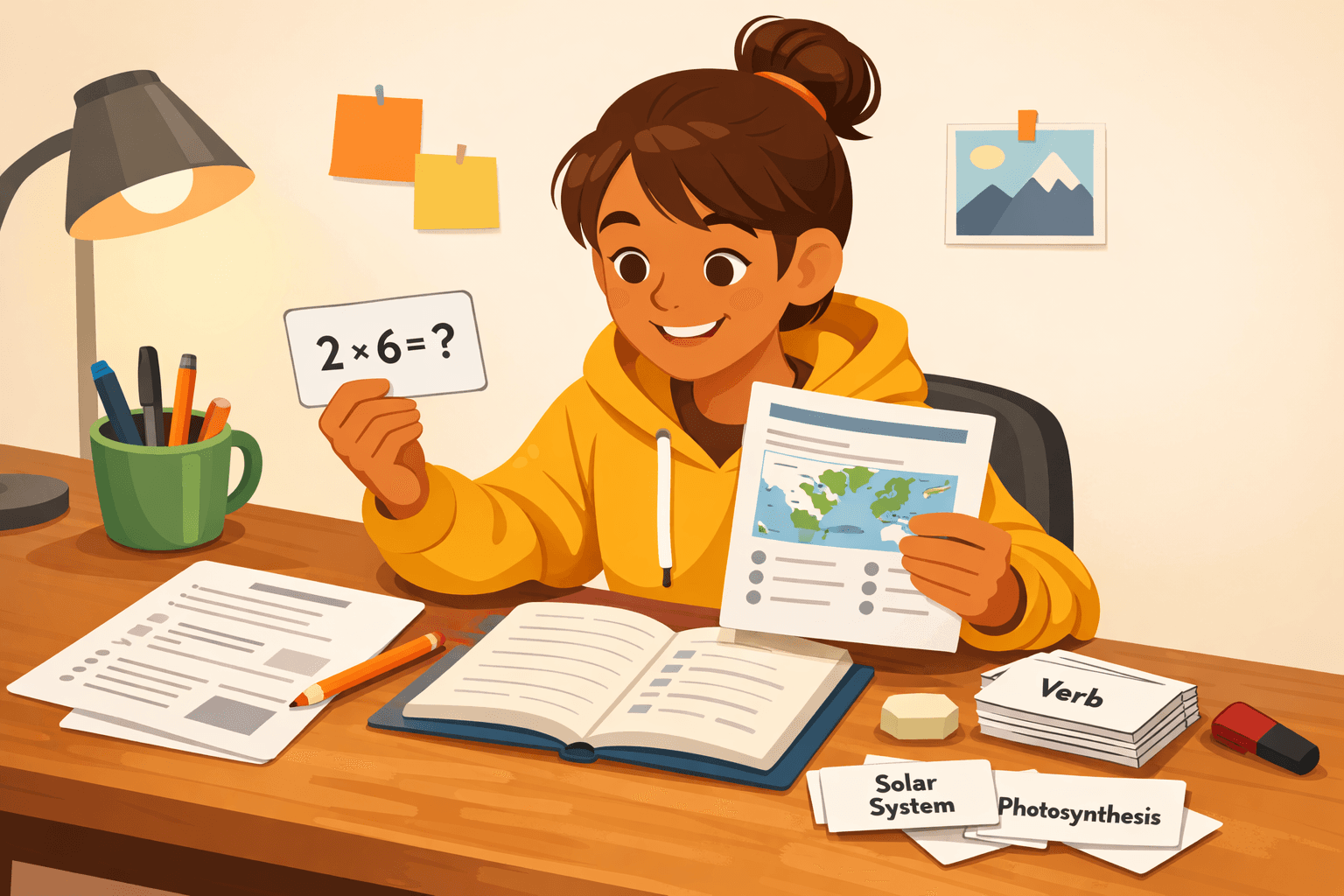
2. Flashcard Retrieval
The key is using flashcards correctly:
- Look at the question side
- Actually try to recall the answer (don't just flip immediately)
- Say or write your answer
- Then check the back
Common mistake: Flipping the card before genuinely attempting recall defeats the purpose entirely.
3. The Question Method
Transform your notes into questions:
- "What is X?"
- "How does X relate to Y?"
- "Why does X happen?"
- "What are the three types of X?"
Then answer these questions without looking at your notes.
4. Practice Problems
For math, science, and technical subjects:
- Work through problems without looking at solutions
- Struggle is productive – resist the urge to peek
- Check your work only after completing the problem
- Analyze mistakes thoroughly
5. The Teach-Back Technique
Explain the concept as if teaching someone else:
- Use simple language
- Cover all key points from memory
- Draw diagrams without references
- Answer potential questions
This is the foundation of the Feynman Technique that Stuley's Feynman AI is built upon.
6. Cornell Note Review
If you use Cornell notes:
- Cover the main notes column
- Use only the cue column (questions/keywords)
- Try to recall the full information
- Uncover to check accuracy
7. Closed-Book Summaries
After each study session:
- Close all materials
- Write a summary of what you learned
- Include key concepts, definitions, and connections
- Compare with source material
Building an Active Recall Study System
Daily Practice Structure
Morning Review (15-20 minutes)
- Review flashcards from previous days (spaced repetition)
- Practice active recall on weak areas
- Test yourself on new material from yesterday
Study Sessions (per topic)
- Read/learn new material (30 minutes)
- Close books, practice active recall (15 minutes)
- Check and correct (10 minutes)
- Create flashcards for difficult items (5 minutes)
Evening Review (10-15 minutes)
- Quick active recall of day's learning
- Identify tomorrow's focus areas
Weekly Integration
- Monday-Friday: Learn new material with active recall
- Saturday: Comprehensive active recall test of week's material
- Sunday: Review weak areas identified Saturday
Common Mistakes to Avoid
Mistake 1: Giving Up Too Quickly
When you can't recall something, the temptation is to immediately check the answer. Resist this.
The struggle to remember – even if unsuccessful – strengthens memory more than easy retrieval. Wait at least 10-15 seconds before checking.
Mistake 2: Only Using Recognition-Based Testing
Multiple choice questions often test recognition, not recall. While useful, they're not as effective as:
- Free recall (write everything you know)
- Short answer questions
- Fill-in-the-blank exercises
Mistake 3: Not Testing Soon Enough
Active recall works best when combined with the initial learning phase. Don't wait until the night before the exam – start testing yourself immediately after learning.
Mistake 4: Skipping Difficult Material
It's tempting to skip flashcards you find hard. But difficult items need more retrieval practice, not less. The effort is what builds memory.
Mistake 5: Passive Flashcard Review
Flipping through flashcards while watching TV isn't active recall. You need focused attention and genuine retrieval attempts.
Active Recall for Different Subjects
Sciences (Biology, Chemistry, Physics)
- Create flashcards for terminology and formulas
- Practice solving problems without notes
- Draw diagrams from memory (cell structures, chemical reactions)
- Explain mechanisms step-by-step
Mathematics
- Work through problem sets without solutions visible
- Recreate proofs from memory
- Practice formula derivation
- Test yourself on theorem statements
Languages
- Active vocabulary recall (L2 → L1 and L1 → L2)
- Grammar rule application through exercises
- Speaking practice without notes
- Writing from prompts
History and Social Sciences
- Create timeline summaries from memory
- Practice explaining cause-and-effect relationships
- Write essays without references
- Connect events across different periods
Medical/Nursing Studies
- Anatomical diagram labeling from memory
- Patient scenario analysis
- Drug mechanism recall
- Diagnostic reasoning practice
How Stuley Supercharges Active Recall
At Stuley, we've built an entire platform around active recall principles:
AI-Generated Questions
Upload any material – notes, PDFs, lecture recordings – and our AI automatically creates questions designed for optimal active recall practice.
Intelligent Flashcards
- Auto-generated from your study materials
- Designed to prompt genuine recall
- Integrated with spaced repetition for maximum retention
Feynman AI
Our AI teaching assistant takes active recall further:
- Explain concepts to Feynman AI
- Receive probing questions that test your understanding
- Identify gaps you didn't know existed
- Get guidance on areas needing more study
Performance Analytics
Track how your active recall practice is improving:
- Recall accuracy over time
- Topics needing more attention
- Optimal review scheduling
Research Supporting Active Recall
Key Studies
Roediger & Karpicke (2006): Students who practiced retrieval after reading passages retained 50% more information after one week than those who simply re-read the material.
Karpicke & Blunt (2011): Active recall produced significantly better learning than concept mapping or studying – even for complex, conceptual material.
McDaniel et al. (2007): Middle school students who took short quizzes retained 13% more information on final exams than those who didn't.
The Testing Effect in Practice
A meta-analysis of 118 studies confirmed:
- Testing (active recall) produces better learning than re-studying
- The effect holds across different subjects and age groups
- Benefits increase with longer retention intervals
Getting Started Today
This Week's Challenge
- Day 1-2: Learn the blank page method with one subject
- Day 3-4: Create question-based flashcards for another subject
- Day 5: Combine techniques – use both methods
- Day 6: Review all material using only active recall
- Day 7: Assess what worked best for you
Start Small
Don't overhaul your entire study system at once:
- Pick one subject to experiment with
- Try active recall for 2 weeks
- Track your results (quiz scores, exam performance)
- Expand to other subjects based on results
Conclusion
Active recall isn't just another study tip – it's the most powerful learning technique we know of. The science is clear: retrieving information from memory strengthens it far more than passive review ever can.
The best part? Active recall is actually more efficient than traditional studying. You'll spend less total time while retaining more information.
Stop re-reading your notes. Start testing yourself. Your grades will thank you.
Ready to implement active recall with AI assistance? Stuley automatically creates active recall exercises from your study materials. Try it free and experience the difference.